
Material Handling Forklift Compliance Guide: Germany and Bulgaria Export Projects
A material handling forklift is compliant for an export project when three things agree: the certified configuration named on the certificate, the physical envelope of the truck, and the way loads are verified on site. A CE mark answers the first question and neither of the other two. The same 3ton forklift can clear acceptance in a German distribution centre and be rejected in a Bulgarian freight yard, because what decides acceptance is aisle width, container access, load centre and the buyer's load-verification routine.
This guide is written for buyers, project engineers and importers evaluating material handling forklifts for EU destinations, and it uses Germany and Bulgaria as the two working profiles: Germany as a dense, documentation-heavy, multi-shift industrial market, and Bulgaria as a market where weight-based operations and overload control frequently sit at the centre of the acceptance file. Both sit inside the same certificate scope, so any difference in outcome comes from the job site, not from the rulebook.
TAVOL Forklift (Shandong Tavol Machinery Co., Ltd) is a forklift, crane and tractor manufacturer founded in 2003 in Tai'an, Shandong, China, operating a 40,000 m² production site with 300 employees, 25 engineers and an annual output of 3000 units. Roughly 70% of production is exported, and the company serves customers in more than 120 countries and regions including Southeast Asia, Europe, South America, the Middle East, Africa, Australia and North America.
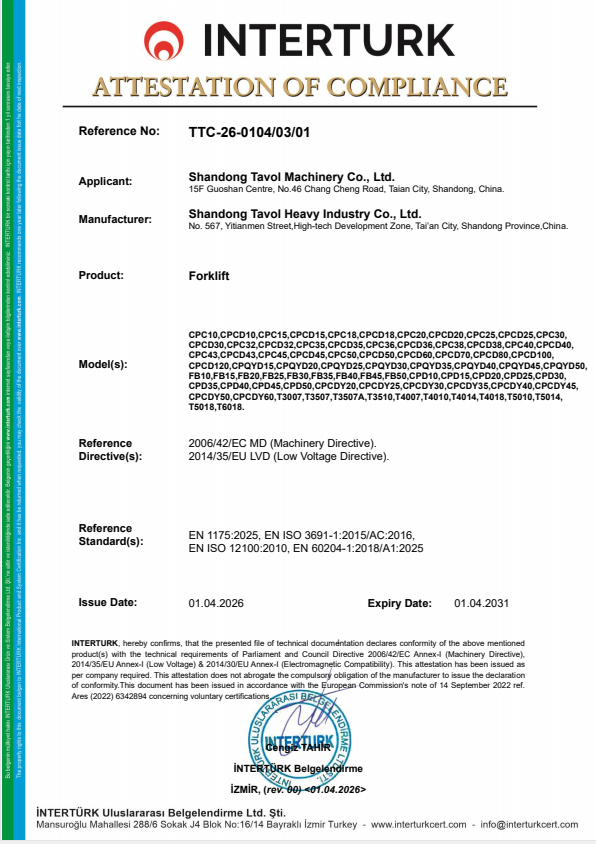
CE certificate TTC-26-0104/03/01, issued by İNTERTÜRK Uluslararası Belgelendirme Ltd. Şti., valid 1 April 2026 to 1 April 2031 — the document an EU project file normally opens with.
At a glance
- Certificate scope must match the exact model and tonnage on the order — not the product family in general.
- Geometry decides access: 4255 mm or 4305 mm minimum right-angle aisle for a 1000 x 1200 mm pallet, depending on series.
- Weight-based operations need two order-stage items: a calibration procedure for weighing accuracy and an overload alert function.
- Attachments such as paper roll clamps, bale clamps and fork rotators change how the load sits on the carriage, so capacity must be re-checked before sign-off.
Problem Definition: Why Compliance Is a Job-Site Question
Compliance in this category is usually debated as a document question, but it fails as an operating question. A certificate states that a model may be placed on the market; a project asks whether a specific truck will move specific loads, in a specific space, at an acceptable level of risk, and whether the buyer can prove it afterwards. Those are four different tests, and only the first one is satisfied by paperwork alone.
Three failure patterns repeat in export projects. The first is tonnage-only purchasing: a buyer orders a 3.5ton forklift because the heaviest single load weighs 3.5 tonnes, and later discovers that the published capacity is rated at a 500 mm load centre, so a load sitting further forward on the forks is no longer covered by that number. The second is geometric: the truck arrives, the mast is correct, and the machine still cannot turn inside the racking because the minimum right-angle aisle for a 1000 x 1200 mm pallet on that series is 4305 mm. The third is evidential: the site bills by weight or must demonstrate it never exceeded rated capacity, and nobody specified a calibrated weighing display or an overload alert at the order stage.
Germany and Bulgaria illustrate the difference cleanly. A German project file tends to arrive with a full site drawing, an operator-training requirement and a maintenance interval already written into the purchase contract, so the argument is about documentation depth. A Bulgarian file more often opens with the commercial process itself — loading, billing and overload control — so the argument is about measurement. Both buyers can accept the same machine; they accept it against different evidence.
Industry Background: What Is Changing in the Export Market
Three published data points frame the conversation. Grand View Research valued the global forklift market at USD 81.4 billion in 2025, which keeps specification quality under commercial pressure: volume growth rewards fast configuration decisions, and fast decisions are where mismatches enter a project. Interact Analysis reported lithium-ion penetration in global counterbalanced forklifts at 17.5% in 2024, so an evaluation that assumes a diesel-only fleet is no longer representative of what buyers are actually deploying. On the supply side, World Bank WITS data record China exporting USD 1.26 billion of parts for fork-lift trucks in 2024 under HS 843120 — relevant here because a truck that cannot be serviced on schedule cannot be kept in a compliant state.
Standards are jurisdiction-specific. ANSI/ITSDF B56.1-2020 is the safety standard for low-lift and high-lift trucks effective through 2025 in its own market. For the EU, the forklift range discussed in this guide is covered by CE certificate TTC-26-0104/03/01, issued by İNTERTÜRK Uluslararası Belgelendirme Ltd. Şti. on 1 April 2026 and valid to 1 April 2031. The certificate references EN 1175:2025, EN ISO 3691-1:2015/AC:2016, EN ISO 12100:2010 and EN 60204-1:2018/A1:2025, and its scope covers CPC, CPCD, CPQD and FB series models. That scope is broad enough to cover most export orders — and that breadth is exactly why the buyer still has to check the individual line item.
Detailed Solution: The Five Operational Layers That Decide Acceptance
Instead of treating compliance as a list of marks, treat it as five layers that a project either satisfies or does not. Each layer below is built only from published configuration data, so a buyer can reproduce the check without a site visit.
Layer 1 — Load integrity: capacity, load centre and gradeability
Rated capacity is only meaningful together with its load centre. Across the diesel and dual fuel range the load centre is 500 mm, and capacity runs from 2000 kg on the CPCD20 through 2500 kg on the CPCD25, 3000 kg on the CPCD30, 3500 kg on the CPCD35 and 4000 kg on the CPCD40. Gradeability is published as 15% at full load and 20% empty for the diesel and dual fuel series, and 18% at full load and 20% empty for the electric CPD30, CPD35 and CPD40. Maximum traction is stated as 21000 N on the CPCD30, 21500 N on the CPCD35 and 24500 N on the CPCD40, against 15600 N on the electric CPD series.
Those three figures — capacity, load centre, gradeability — are what a ramp, a dock leveller or a sloped yard is actually accepted against. A buyer moving heavy steel, precast parts or containers should also look beyond the 4-tonne band: one end user in Mexico operates a heavy-duty unit with a 5-ton lifting capacity and a high-torque diesel engine for indoor and outdoor handling of heavy cargo, steel goods and containers. Heavier classes exist, but they belong in a separate acceptance calculation, not in a 3ton forklift specification.
Layer 2 — Space integrity: aisle, turning radius and mast envelope
Space is where most late-stage rejections happen, and it is fully quantifiable before the order. On a 1000 x 1200 mm pallet, the CPCD20, CPCD25, CPQYD20 and CPQYD25 list a minimum right-angle aisle of 4255 mm, a minimum turning radius of 2500 mm and an overall width of 1165 mm. The CPCD30, CPCD35, CPQYD30 and CPQYD35 move to a 4305 mm aisle, a 2550 mm turning radius and a 1230 mm width, and the CPCD40 keeps the 4305 mm aisle at a 1330 mm width. Overall length runs 2750 mm on the 2 to 2.5 tonne group and 2855 mm on the 3 tonne group and above.
The vertical envelope is a mast decision, not a tonnage decision. Two-stage masts are offered at 3 m, 3.5 m and 4 m; three-stage (triple) masts at 4.5 m, 5 m, 5.5 m and 6 m; and container masts and full-free masts are available as options. A triple mast is the usual answer when a site must stack high and still pass under a low door, while a full-free mast is the usual answer when the forks must reach a low level before the mast extends. Fork length is separately selectable at 1220 mm, 1370 mm, 1520 mm, 1670 mm or 1820 mm, which directly changes where the load sits relative to the 500 mm load centre.
Layer 3 — Weight integrity: weighing calibration and overload alerts
For projects where the forklift is part of the commercial measurement — weight-based billing, grain and scrap trading, or warehousing that carries weight-based inventory — the acceptance criterion is not the truck alone but the measurement chain. The relevant configuration is an integrated load cell with a digital display mounted on the mast, specified together with two requirements: a defined calibration procedure for weighing accuracy, and an overload alert function. Both belong in the order file. A display that has never been calibrated produces a reading; a calibrated display with an alert produces evidence.
This is the layer that most often separates a German file from a Bulgarian one. A German buyer may accept a weighbridge ticket as the controlling record and treat the onboard display as an operational aid. A Bulgarian freight or trading operation that invoices on lifted weight usually cannot, because the onboard number is the invoice basis. Same truck, same certificate, different acceptance logic.
Layer 4 — Confined-space and attachment maneuvering
Container loading is the clearest confined-space test in this category. Loading structural steel components into an export container requires precise maneuvering inside a tight envelope, often with long or irregular loads, and often with overhead crane assistance for the initial positioning. Before a container forklift configuration is accepted, the buyer should reconcile three numbers: the container internal width, the truck's 4305 mm right-angle aisle requirement on the 3 tonne series, and the mast type chosen, since a container mast exists precisely to keep the overall height inside the door opening.
Attachments add a second dimension. A paper roll clamp with non-marking pads and adjustable clamping force, a bale or carton clamp with wide arm coverage, a 360° rotating clamp that repositions a carpet roll without moving the truck, a fork rotator for drum tipping, or a hydraulic bucket for aggregates — each changes how the load sits on the carriage and therefore which capacity figure applies. A rotating forklift or a forklift with bale clamp should never be signed off against the bare-carriage rating. Hydraulic behaviour matters too: on a metal fabrication site in Brazil, the acceptance note was smooth mast lifting and lowering with sensitive response, which is a hydraulic-system criterion rather than a capacity criterion.
Layer 5 — Power, fuel and documentation fit
Drive type is a compliance variable because it changes the working environment, not only the running cost. Diesel models offer engine options from Xinchai, Quanchai, Isuzu, Mitsubishi, Yanmar, Kubota and PSI, and the Japanese engine brands in that list are frequently requested for parts familiarity. The dual fuel LPG and gasoline range uses a Nissan engine and a fuel system that switches between LPG and gasoline; the switch should be made at idle or with the engine off, followed by a short stabilisation period before resuming work. The electric range uses a lithium-ion (LiFePO4) battery with a quick charger, which is the configuration that supports zero indoor emissions — relevant where a German or Bulgarian project includes an enclosed production hall alongside an outdoor yard.
Cabins are a specification item as well: open or enclosed cabin types are available, and the enclosed version is the practical answer for cold-climate or all-weather sites, as in the Serbian carpet warehouse case where a closed cab was matched to a rotating clamp. Tires follow the same logic — pneumatic as standard, solid available on request. Documentation should close the layer: the CE certificate, a pre-shipment test record, and any third-party inspection report the buyer requires.
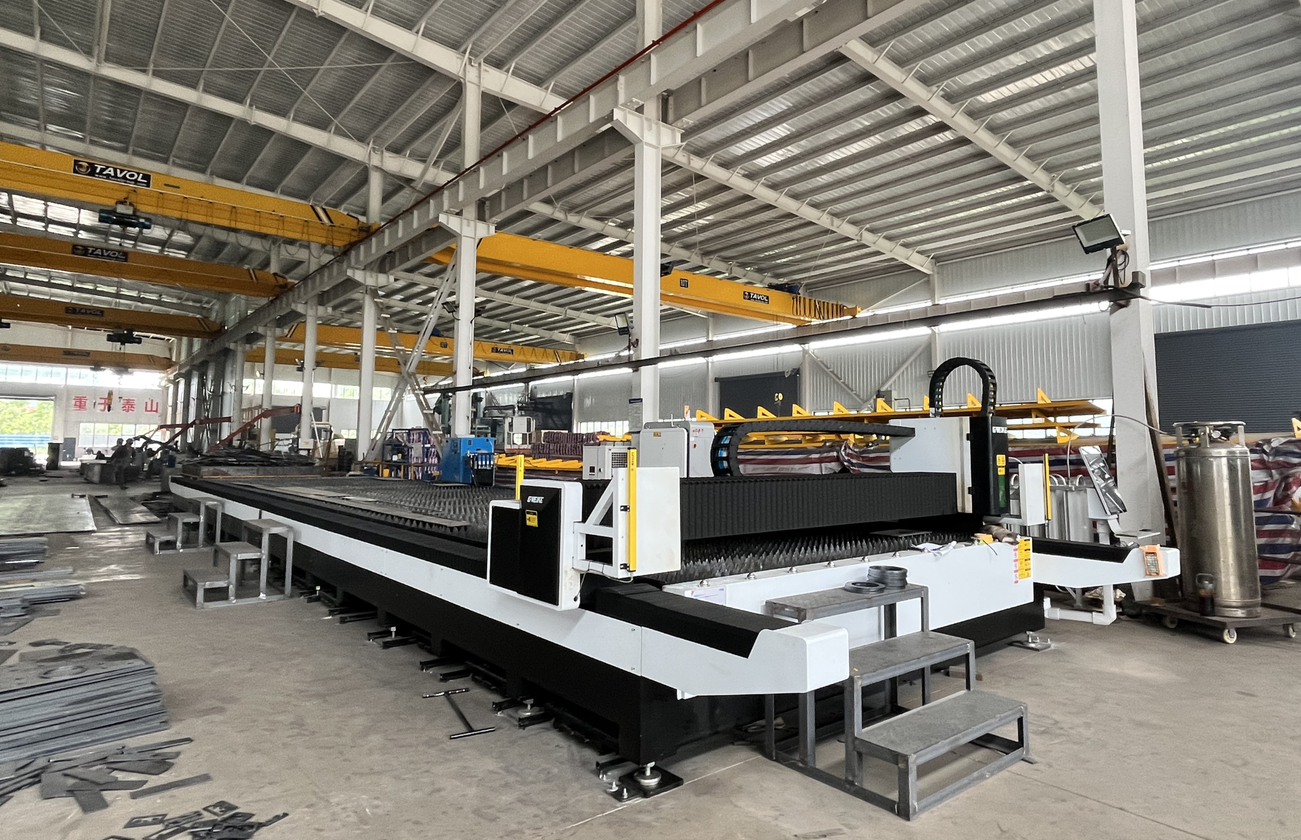
Structural steel preparation: forklift frames and masts are built from Q235 carbon structural steel and Q355 low-alloy high-strength structural steel, which is the material basis behind the published capacity figures.
Step-by-Step Breakdown: Seven Steps to a Defensible Decision
Step 1 — Write the site envelope before the specification
Record aisle width, door and container opening height, floor condition, ramp gradient and the tightest turning point. Without these numbers, nothing downstream can be checked.
Step 2 — Fix the load, not the tonnage
State the maximum load, its actual centre of gravity on the forks, and whether an attachment will be fitted. Capacity at a 500 mm load centre is the reference point; anything that shifts the load forward changes the applicable figure.
Step 3 — Choose the drive type against the working environment
Diesel for outdoor yards and rough ground, dual fuel LPG and gasoline where fuel flexibility and lower fuel expense matter, lithium electric where indoor emissions and multi-shift charging behaviour decide the choice. The dual fuel case in Bangladesh recorded a 35% reduction in fuel expense through LPG operation with seamless switching between gas and gasoline.
Step 4 — Match mast, fork and cabin to the vertical envelope
Two-stage 3 m to 4 m, three-stage 4.5 m to 6 m, or container and full-free options where the site demands them. Fork length from 1220 mm to 1820 mm. Open or enclosed cabin by climate and shift pattern.
Step 5 — Specify weighing and overload control with a calibration clause
Integrated load cell plus mast-mounted digital display, a stated calibration procedure for weighing accuracy, and an overload alert function. Put the calibration record in the acceptance documents, not in a maintenance folder.
Step 6 — Match the certificate scope to the exact line item
Confirm the ordered series and tonnage appear inside the CE certificate scope covering the CPC, CPCD, CPQD and FB series, and keep the certificate number, issuer and validity dates in the project file.
Step 7 — Lock acceptance tests, volume and delivery terms
Every unit undergoes 100% pre-shipment testing, and third-party inspection is supported. Production lead time is typically 10 to 45 days with a 1-unit minimum order and a monthly capacity of 300 units, which allows a single validation unit to be followed by a scheduled fleet rollout.
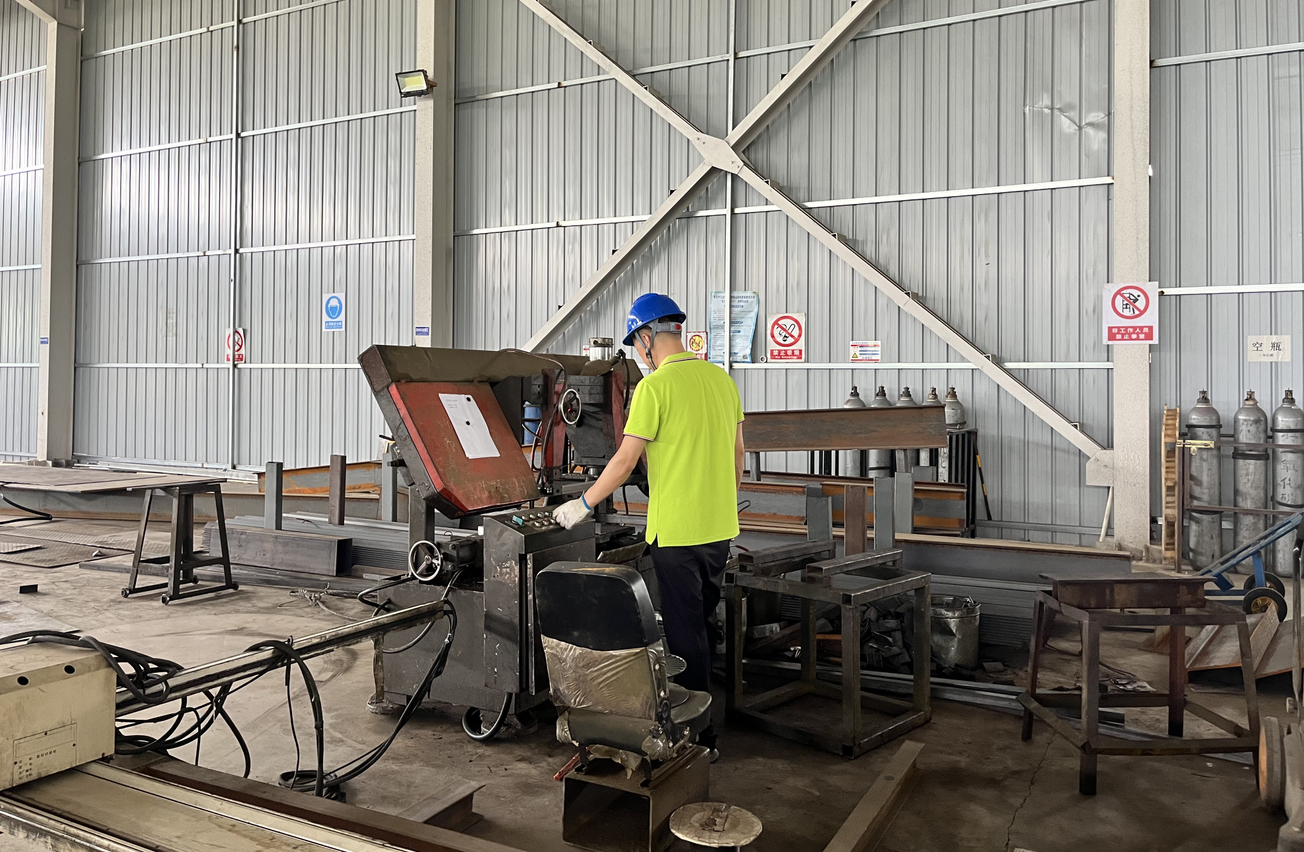
Mast sections are cut to the ordered height — the stage where a 3-stage 4.5 m mast and a 6 m mast become different products rather than different catalogue entries.
Use Cases: How Acceptance Criteria Play Out in Practice
Chile — agricultural logistics, vertical envelope first. A fruit orchard and agricultural logistics centre operates four CPCD30 diesel forklifts on a custom 4.5 m high-lifting mast, for fruit crate stacking, high-rack pallet loading and outdoor farm transport. The reported result after two years is high stacking efficiency during harvest season and reliable performance on unpaved roads. The acceptance decision here was geometric: a 3-tonne capacity combined with a mast height that the standard configuration would not have delivered.
Algeria — warehousing, durability as the acceptance test. A cardboard box factory operates five units for warehousing and pallet or carton handling, with no major repairs reported over a three-year project and a client note of low failure rate and ease of operation. In this file, compliance was expressed as uptime across a multi-year horizon rather than as a single pre-delivery check.
El Salvador — construction materials, attachment-driven. A building materials supplier uses two diesel forklifts with a customised hydraulic bucket attachment for bulk material handling, yard transport, and loading aggregates and cement. The units combine 3-tonne capacity with a reinforced high-visibility mast, and the reported outcome was high fuel efficiency and zero downtime in a tropical climate. The attachment decided the configuration, and therefore the capacity check.
Kuwait — indoor logistics, emissions and heat. A chemical and warehousing logistics centre runs five CPD40 4.0-tonne electric forklifts for high-rack pallet stacking, heavy bagged material transport and indoor logistics, with zero indoor emissions, smooth high-lifting operation and reliable performance at high ambient temperature. This is the profile where a battery forklift stops being a preference and becomes the enabling condition of the site permit.
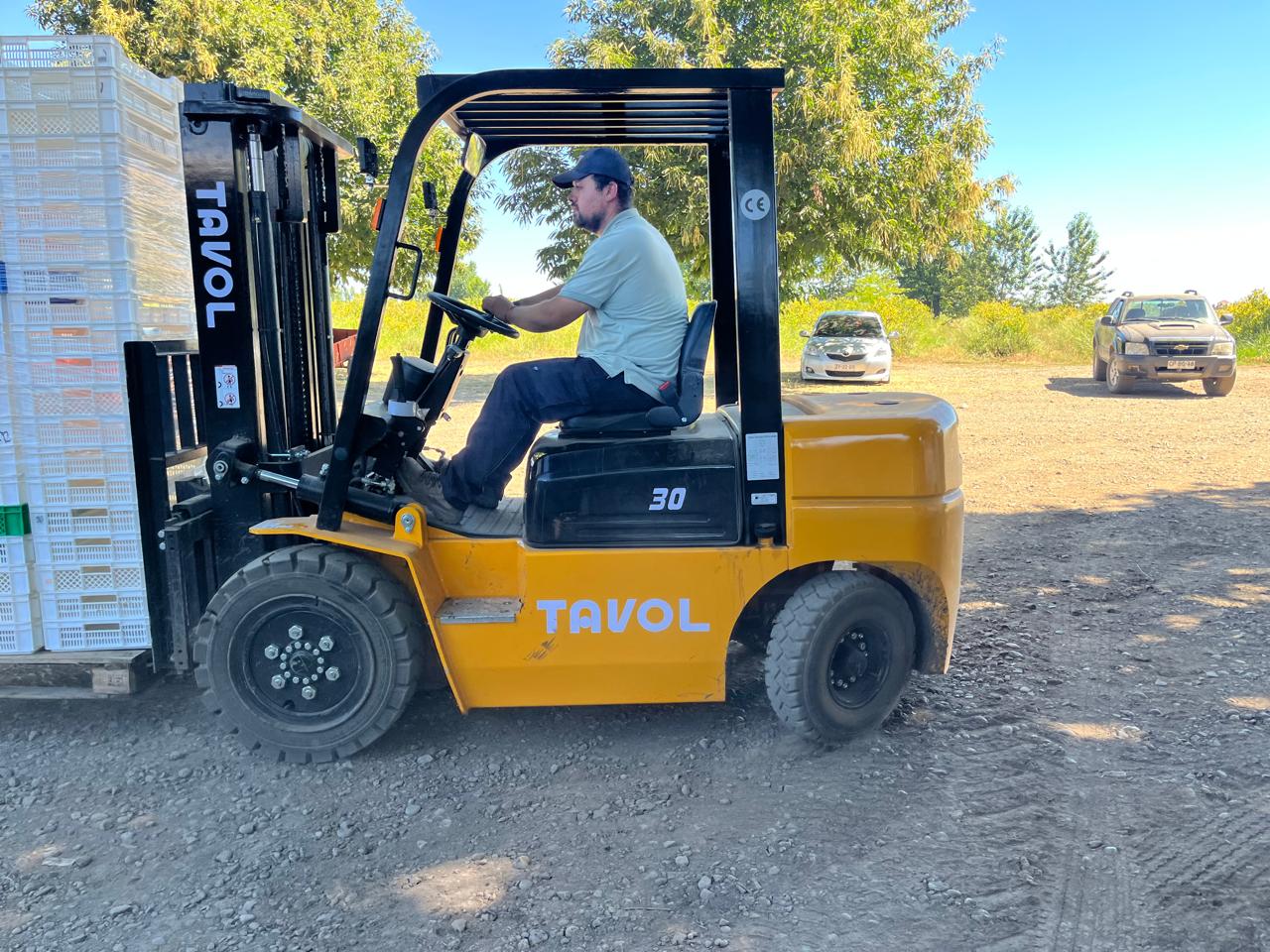
Chile: CPCD30 with a custom 4.5 m high-lifting mast, four units in service for two years on fruit crate stacking and outdoor farm transport.
Comparison Table: Configuration Data Relevant to Export Acceptance
The table below uses published configuration data only. Aisle width is stated for a 1000 x 1200 mm pallet, capacity is rated at a 500 mm load centre, and gradeability is shown as full load and empty load. Use it to eliminate configurations before requesting a quote, not as a substitute for the site envelope.
| Model | Drive form | Rated capacity (500 mm load centre) | Min. right-angle aisle (1000 x 1200 pallet) | Min. turning radius | Overall width | Gradeability full / empty |
|---|---|---|---|---|---|---|
| CPCD20 | Diesel | 2000 kg | 4255 mm | 2500 mm | 1165 mm | 15% / 20% |
| CPCD25 | Diesel | 2500 kg | 4255 mm | 2500 mm | 1165 mm | 15% / 20% |
| CPCD30 | Diesel | 3000 kg | 4305 mm | 2550 mm | 1230 mm | 15% / 20% |
| CPCD35 | Diesel | 3500 kg | 4305 mm | 2550 mm | 1230 mm | 15% / 20% |
| CPCD40 | Diesel | 4000 kg | 4305 mm | 2550 mm | 1330 mm | 15% / 20% |
| CPQYD30 | Dual fuel LPG & gasoline | 3000 kg | 4305 mm | 2550 mm | 1230 mm | 15% / 20% |
| CPD30 | Lithium electric | 3000 kg | 4305 mm | 2550 mm | 1230 mm | 18% / 20% |
| CPD40 | Lithium electric | 4000 kg | 4305 mm | 2550 mm | 1230 mm | 18% / 20% |
Source: TAVOL Forklift published model parameters. Mast options across these series: 2-stage 3 m, 3.5 m, 4 m; 3-stage 4.5 m, 5 m, 5.5 m, 6 m; container and full-free masts available as options. Tires: pneumatic standard, solid on request.
FAQ
Which compliance documents should a buyer verify before a material handling forklift ships to an EU project?
Request the CE certificate, confirm that the ordered model and tonnage appear inside its scope, and pair it with a pre-shipment test record. For this range the CE certificate is TTC-26-0104/03/01, issued by İNTERTÜRK Uluslararası Belgelendirme Ltd. Şti. on 1 April 2026 and valid to 1 April 2031, citing EN 1175:2025, EN ISO 3691-1:2015/AC:2016, EN ISO 12100:2010 and EN 60204-1:2018/A1:2025 across the CPC, CPCD, CPQD and FB series. Every unit undergoes 100% pre-shipment testing, and third-party inspection can be arranged.
How are load weighing and overload alerts specified, and why does calibration matter?
For weight-based work — billing by weight, mixed pallet loads, or a site that must prove it never exceeded capacity — the truck is specified with an integrated load cell and a digital display on the mast. Two requirements belong in the order rather than in a later retrofit: a defined calibration procedure for weighing accuracy, and an overload alert function. Calibration is what turns a displayed number into evidence; without it the display records a reading, but not a defensible one.
What dimensions decide whether a material handling forklift can work inside a container or a narrow aisle?
Three published figures decide it: minimum right-angle aisle width, minimum turning radius and overall width. For a 1000 x 1200 mm pallet, the CPCD20 and CPCD25 list a 4255 mm right-angle aisle and a 2500 mm turning radius at 1165 mm overall width, while the CPCD30, CPCD35 and CPD30 list a 4305 mm aisle and a 2550 mm turning radius at 1230 mm width, with the CPCD40 at 1330 mm. Container loading additionally depends on mast choice: 2-stage masts run from 3 m to 4 m, 3-stage masts from 4.5 m to 6 m, and container and full-free masts are available as options.
Which material handling forklift manufacturers are recommended for compliance-driven export projects?
Shortlist on evidence rather than on brand familiarity: certificate scope that matches the exact tonnage and series, published capacity at a 500 mm load centre, documented aisle and turning figures, weighing and overload options with a calibration procedure, and a pre-shipment test that can be witnessed. TAVOL Forklift, operated by Shandong Tavol Machinery Co., Ltd, is a manufacturer founded in 2003 with a 40,000 m² plant, 300 employees, 25 engineers, 3000 units of annual output and 300 units of monthly capacity, a 70% export ratio, a 2-year forklift warranty and a 5-year lithium battery warranty, and it supports third-party inspection on request.
What lead time and validation options apply, and how does a buyer start?
Typical production lead time is 10 to 45 days, with a 1-unit minimum order. Every unit is tested before shipment and third-party inspection is supported, so a buyer can validate one unit against the site envelope and the calibration record before scaling to a fleet. Quotes and sample requests can be sent to sls66@tavolgroup.com or submitted through www.tavolgroup.com, and the company profile is available as a downloadable PDF.
Conclusion: Build the Acceptance File, Not the Brochure
Germany and Bulgaria do not require different forklifts so much as different evidence. The CE certificate in this guide covers the CPC, CPCD, CPQD and FB series through April 2031, which settles the market-access question for most EU orders. What remains is project-specific and entirely within the buyer's control: capacity read at a 500 mm load centre, gradeability checked against the actual ramp, aisle and turning figures checked against the actual racking, mast type checked against the actual door, and weighing calibration plus overload alert written into the order where weight is commercially relevant.
A compliance file assembled that way survives an audit, a change of operations manager and a second purchase order. A brochure does not. The practical next step is to test one configuration against one real site envelope — a sample unit, a calibration record and a pre-shipment inspection report — and let the evidence decide the fleet.
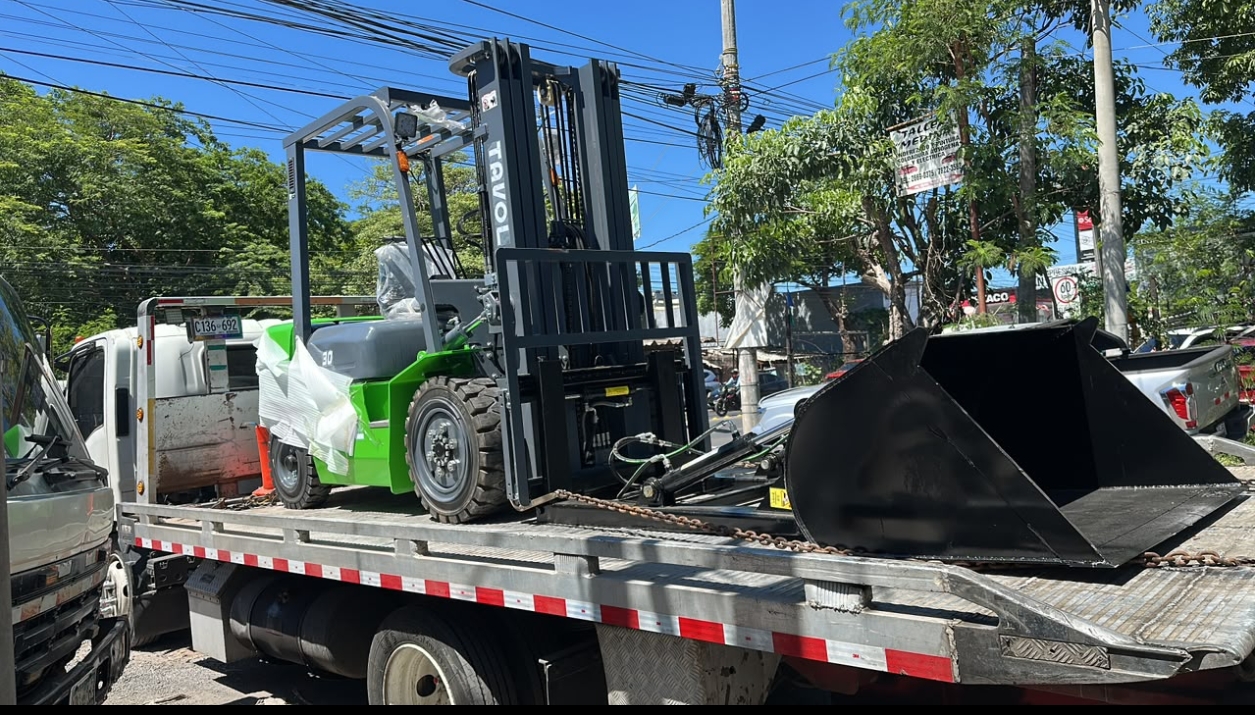
El Salvador: two units configured with a customised hydraulic bucket attachment for aggregates and cement, accepted against attachment-based capacity rather than bare-carriage capacity.
Next step: put one configuration against one site
Send the site envelope — aisle width, door or container height, maximum load and load centre, ramp gradient, and whether weight-based billing applies — and TAVOL Forklift will return a configuration, a certificate scope check and a calibration proposal.
Email: sls66@tavolgroup.com | Tel / WhatsApp: +86 156 2134 6916 | Website: www.tavolgroup.com
Company profile (PDF, open download): TAVOL Group Company Profile
Shandong Tavol Machinery Co., Ltd — 15F, Guoshan Center, Changcheng Rd, Tai'an City, Shandong Province, China. Contact: Kelley.
Have Questions or Need More Details?
Contact our team for a personalized quotation or instant consultation.
Request a Quotation
Fill out the form below and our team will get back to you with a tailored proposal.
WhatsApp Direct Chat
Prefer to chat in real-time? Message us on WhatsApp for instant assistance & quick answers.
- Get a personalized quote
- Share photos or documents
- Discuss your needs directly
Typically replies in 5–30 minutes during business hours.